Bhopal
 is the capital of theIndian state of Madhya Pradesh and the administrative headquarters of Bhopal Districtand Bhopal Division. The city was the capital of the former Bhopal State. Bhopal is known as the City of Lakes[2] for its various natural as well as artificial lakes and is also one of the greenest cities in India.[3]
A B-1 class city,[4] Bhopal houses various institutions and installations of national importance. Some of these include ISRO's Master Control Facility,[5] the CSIR, AIIMS Bhopal,[6] National Institute of Fashion Technology (NIFT) AMPRI, MANIT, IISER, SPA,IIFM, BHEL and NLIU. The city attracted international attention after the Bhopal disaster, when a Union Carbide India Limited (UCIL) pesticide manufacturing plant leaked a mixture of deadly gases including methyl isocyanate on the intervening night of 2 / 3 December 1984, leading to the worst industrial disaster in the history of industrialization and a loss of thousands of lives. Since then, Bhopal has been a center of protests and campaigns which have been joined by people from across the globe.
History
In the early 18th century, Bhopal was a small village in the local Gond kingdom. The modern Bhopal city was established by Dost Mohammad Khan (1672–1728), an Afghan soldier in the Mughal army.[9] After the death of the emperor Aurangzeb, Khan started providing mercenary services to several local chieftains in the politically unstable Malwa region. In 1709, he took on the lease of Berasia estate, and later annexed several territories in the region to establish the Bhopal State.[10] Khan received the territory of Bhopal from the Gond queen Rani Kamlapati in lieu of payment for mercenary services, and usurped her kingdom after her death.[11]
| Country | India |
|---|---|
| State | Madhya Pradesh |
| District | Bhopal |
| Government | |
| • Body | Bhopal Municipal Corporation |
| • Mayor | Krishna Gaur (BJP) |
| • Municipal Commissioner | Rajnish Shrivastava |
| Area | |
| • Total | 697.24 km2(269.21 sq mi) |
| Elevation | 427 m (1,401 ft) |
| Population (2011)[1] | |
| • Total | 1,795,648 |
| • Density | 2,575/km2 (6,670/sq mi) |
| Demonym | Bhopali |
| Languages | |
| • Official | Hindi |
| • Other | Urdu |
| Time zone | IST (UTC+5:30) |
| Pincode | 462001 to 462050 |
| Telephone | +91755 |
| Vehicle registration | MP-04- |
| Website | bhopalmunicipal.com |
Nawab Faiz Muhammed Khan (1742–1777) moved the capital from Islamnagar to Bhopal. The state became a British protectorate in 1818. Between 1819 and 1926, it was ruled by four women – Begums – unique in the royalty of those days. Qudsia Begum was the first woman ruler, who was succeeded by her only daughter Sikandar Begum, who in turn was succeeded by her only daughter, Shahjehan Begum. Sultan Jahan Begum was the last woman ruler, who after 25 years of rule, abdicated in favour of her son, Hamidullah Khan. The rule of Begums gave the city its waterworks, railways, a postal system and a municipality constituted in 1907.[14]
 Bhopal was the second largest Muslim state in pre-independence India after Hyderabad. After the independence of India in 1947, the last Nawab expressed his wish to retain Bhopal as a separate unit in March 1948. Agitations against the Nawab broke out in December 1948, leading to the arrest of prominent leaders including Shankar Dayal Sharma. Later, the political detainees were released, and the Nawab signed the agreement for Bhopal's merger with the Union of India on 30 April 1949.[15]
The Bhopal state was taken over by the Union Government of India on 1 June 1949. Sindhi refugees from Pakistan were accommodated in Bairagarh, a western suburb of Bhopal (now renamed to Sant Hirdaram Nagar). According to the States Reorganization Act of 1956, the Bhopal state was integrated into the state of Madhya Pradesh, and Bhopal was declared as its capital. The population of the city rose rapidly thereafter.
See also: Bhopal State (1949-1956)
Bhopal disaster
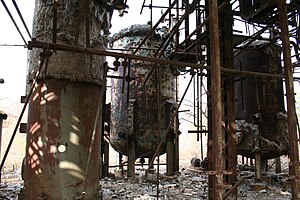 On 3 December 1984, a Union Carbide India Limited pesticide plant in Bhopal leaked around 32 tons of toxic gases, including methyl isocyanate gas which led to the worst industrial disaster to date. The official death toll was initially recorded around 5,000. Many figures suggest that 18,000 died within two weeks, and it is estimated that around 8,000 have died since then of gas-poisoning-related diseases.[16] TheGreenpeace organization cites a total casualty figure of 20,000 as its own conservative estimate. Many more were rendered sick and have been facing chronic health problems such as psychological and neurological disabilities, blindness, skin, vision and breathing disorders[17] and the newborn children still suffer from serious birth defects, even after generations.[18][19] The soil and ground water near the factory site has been contaminated by the toxic wastes and other chemicals still leaking out from the factory.[19][20][21] The Indian government, however, maintains that no such pollution has taken place or that any such toxins are even present at the site.[22] The Bhopal disaster is often cited as the world's worst industrial disaster.[16][23][24] December 3 is annually observed as the official day of mourning, and every year, all government offices in Bhopal remain closed on this day.
The Union Carbide India Limited (UCIL) plant was established in 1969 in the Eastern part of the City. Fifty-one per cent of it was owned by Union Carbide Corporation (UCC) and 49% by Indian authorities. The design of the Methyl isocyanate (MIC) plant, following government regulations, was "Indianized" by UCIL engineers to maximise the use of indigenous materials and products. Mumbai-based Humphreys and Glasgow Consultants Pvt. Ltd., were the main consultants, Larsen & Toubro fabricated the MIC storage tanks, and Taylor of India Ltd. provided the instrumentation.[25] Producing carbaryl pesticide (trade mark Sevin). MIC, an intermediate in carbaryl manufacture, was also used, and in 1979 a plant for producing MIC was added to the site.[16]
 On the night of 3 December 1984, large amounts of water entered the chemical storage tank E610, which contained about 40 tonnes of methyl isocyanate. The resulting reaction increased the temperature of the liquid inside the tank to 200 °C (400 °F). As a result, a large volume of mixed toxic gases leaked from the MIC containing tank, forcing the emergency release of pressure. Consequently there was massive panic among common people as they woke up in a cloud of noxious gases that burned their lungs. About nine thousand people died immediately, and many more were trampled under others who were fleeing.
Theories for how the water entered the chemical storage tank differ. At that time, workers at the plant were cleaning out some chemical pipes with water, and some authorities claim that because of bad maintenance and leaking valves, it was possible for the water to leak into the tank E610. The Union Carbide Corp. maintains that this was not possible, and that the disaster was an act of sabotage by a "disgruntled worker" who introduced water directly into the tank. Much speculation arose in the aftermath, since the government of India and the Union Carbide Corp. did not release the results of their own investigations.[16] A recently published highly researched book, entitled "The Black Box of Bhopal", which has also appended several original documents not scrutinized before, presents a more complete picture about the events on the morning of 3 December 1984, the various investigations and the litigation that followed. It discredits the unproven allegations of the government sponsored CSIRReport of 1985. [26]
The deciding factors that contributed to the disaster included:[16]
- The chemical plant's poorly chosen location—located near a densely populated west city area, instead of the other side of Bhopal City where the company had been offered land.
- Using hazardous ingredient chemicals (methyl isocyanate) instead of less dangerous ones
- Storing these chemicals in large tanks instead of several smaller storage tanks.
- Possible corrosion of the metals in the pipelines
- Poor maintenance at the chemical plant
- Failure of several safety systems, which were not in operation at the time.
- Deficient staffing policies, such as in the number of employees hired and their training for working with dangerous chemicals.
- Negligence on the part of the Union Carbide India, Ltd., and the Governments of India and the state of Madhya Pradesh.
Geography
Bhopal has an average elevation of 500m metres (1401 ft). Bhopal is located in the central part of India, and is just north of the upper limit of the Vindhya mountain ranges. Located on the Malwa plateau, it is higher than the north Indian plains and the land rises towards the Vindhya Range to the south. The city has uneven elevation and has small hills within its boundaries. The major hills in Bhopal comprise of Idgah hills and Shyamala hills in the northern region and Arera hills in the central region.
According to current master plan, the municipality covers 697 square kilometres It has two very beautiful big lakes, collectively known as the Bhoj Wetland. These lakes are the Upper Lake (now renamed to Bhojtal) and the Lower Lake. Locally these are known as the Bada Talab and Chota Talab respectively. The catchment area of the Upper Lake is 360 km² while that of the Lower Lake is 9.6 km². The Upper Lake drains into the Kolar River. The Van Vihar National Park is a national park situated besides the Upper Lake.
Climate
Economy
The Govindpura industrial area has 1044 small- and medium-scale industries involved in various kinds of production activities.
Bharat Heavy Electricals Limited, the largest engineering and manufacturing enterprise in India, has a unit in Bhopal. It occupies a large area in the Eastern Part of the city and maintains a suburb named after it. A majority of the residents of the BHEL Suburb are employed by the unit.
The major industries in the old city are electrical goods, medicinal, cotton, chemicals and jewelry. Other industries include cotton and flour milling, cloth weaving and painting, as well as making matches, sealing wax, and sporting equipment.[27] The residents of Bhopal also engage in large retail businesses. Handicrafts, like zardozi and batua (a small string purse, usually used with Indian traditional dresses) are some of the products of the Old City.[28] In addition, there are also a large number of garages in the Old City which specialise in automobile conversion. These garages produce custom-modified and tuned cars, SUVs and motorbikes.
Bhopal is also home to the DB Corp, informally called the Bhaskar Group (after its major publication Dainik Bhaskar), a Rs. 1700 crore (Rs. 17 billion) business conglomerate with strong presence in media. Its head office is located in Maharana Pratap Nagar. Manjul Publishing House, located in the old city, is a major publishing house made famous by the translation of the Harry Potter series of novels into Hindi.[29]
Mandideep is an industrial suburb of Bhopal. It is located to the South of the city on the NH 12. Mandideep's total exports are worth some 2,300 crore rupees ($500m; £300m) per year, making it the largest industrial area in Madhya Pradesh. The town is home to Hindustan Electo Graphite (HEG), owning the largest graphite electrode plant in the world and is the largest industrial company in the entire state. Hindustan Electro Graphite (HEG) and Lupin Laboratories ltd. are the dominant companies in the suburb, each exports worth around 900 crore rupees.[30] Apart from that, Mandideep also houses the manufacturing plant of Makson group of company, Eicher Tractors for the oldest tractor manufacturers in India.
Education
There are more than 550 state government sponsored schools and affiliated to the Madhya Pradesh Board of Secondary Education (MPBSE) located within the city limits. In addition, there are four Kendriya Vidyalayas in the city affiliated to the Central Board of Secondary Education(CBSE). The city is also served by numerous other private schools affiliated to either CBSE or MPBSE. Some schools are also affiliated to National Institute of Open Schooling (NIOS) andICSE Board, Institution Of Secondary Distance Education (ISDE) or Private Non-Governmental Board of School Education.
Rajiv Gandhi Proudyogiki Vishwavidyalaya, established in 1998, is a multi-campus affiliating university located in Bhopal. It has campuses and affiliated colleges in Bhopal and other major cities of Madhya Pradesh. 217 engineering colleges, 95 pharmacy colleges, 88 MCA colleges, 4 architecture colleges and 85 polytechnic institutions are affiliated to it. UIT RGPV, an engineering institution established in 1986 as the Government Engineering College was granted autonomous status in 2010. Other universities include the Rajiv Gandhi Technical University, the Barkatullah University, the Madhya Pradesh Bhoj Open University (for distance education), the Sikkim Manipal University of Distance Education and the Makhanlal Chaturvedi National University of Journalism and SNGGPG college.
Maulana Azad National Institute of Technology (MANIT), established in 1960, is the premier institute for technology in the city and has been categorized by the Government of India as an Institute of National Importance. There are several other public and private engineering schools (numbering almost 90) located in and around the city.
Railways

Bhopal lies in the West Central Railway Zone. Considering both North-South and East-West train routes, it is one of the best connected city in India. It houses the Divisional Railway Managers (DRM) head office under Central railways. Following are the railway stations in Bhopal:
- Bhopal Junction Railway Station[37] is the largest and most important railway station in the city. Being on the main North-South line, it is connected by rail to all parts of the country except North-Eastern states. More than 150 daily trains have stoppages in Bhopal.[37]
- Habibganj Railway Station[37] is a major and the most developed station of Bhopal. It holds the distinction of being the first ISO 9000:2001 certified railway station in India.
- Misrod Railway Station[37] is located in the Misrod suburb of the city.
- Mandideep Railway Station[37] is located in the industrial town of Mandideep.
- Sukhsewanagar
- Bairagarh[37] is located in the north-western Bairagarh suburb.
[edit]Airport

The National Institute of Technical Teachers' Training and Research (NITTTR), established by Ministry of HRD, Govt. of India in 1966 as TTTI, is also located in Bhopal. It offers M. Tech., Ph.D.,MBA and Training courses. Other Central Government-run institutes in the city include Indian Institute of Science Education and Research (IISER) and School of Planning and Architecture(SPA, established 2008).[31]
Gandhi Medical College, Bhopal is the city's oldest and most prominent medical college and is associated with Hamidia Hospital, Sultania Zanana Hospital, Kamla Nehru Hospital. The medical college is affiliated to the Barkatullah University. The hospital and the college played a crucial role in emergency response and care after the Bhopal Disaster. Barkatullah University gives affiliation to renowned colleges like Bhopal School of Social Sciences, Institute for Excellence in Higher Education (IEHE), Rajiv Gandhi College, Etc.
Other prominent educational institutes include the Indian Institute of Forest Management, National Institute of Fashion Technology (NIFT), the National Judicial Academy (for training judges) and theNational Law Institute University, one of the premier law schools in India. Other city institutes of learning that offer a diploma in education are the Regional Institute of Education (RIE) of Bhopal, a constituent unit of the National Council of Educational Research & Training (NCERT) and the Digdarshika Institute of Rehabilitation and Research, a non-profit and educational organization serving the health sector.
Government and politics
Bhopal is the capital city of Madhya Pradesh. It houses the State Legislative Assembly, or theVidhan Sabha, which seats 230 members of Legislative Assembly. The twelfth (and current) Vidhan Sabha was elected in May 2008.[32] As of April 2012, the party in the majority in Vidhan Sabha is Bharatiya Janata Party (BJP) which is led by Shri Shivraj Singh Chauhan. Bhopal district elects seven seats to the Assembly.
The administration of Bhopal city is handled by Bhopal Municipal Corporation, also known as BMC. The total area under BMC is 285 km². The city is divided into 66 wards. Each ward elects a corporator. The winning party elects a council of members, who are responsible for various departments. The council members chose the Mayor among themselves. At present, there are ten members in the council. The Commissioner of Bhopal is the highest officer of Municipal Corporate Office, which is responsible for the departments of public works, revenue and tax, water supply, planning and development, fire brigade, health and sanitation, finance and accounts etc. The current Municipal Commissioner of Bhopal is Shri Manish Singh, while the current Mayor is Shrimati Krishna Gaur.
Transportation
Local transport
Bhopal has been a railroad and highway transportation hub for a long time. Bhopal has its own city bus service: Bhopal City Link Limited, which operates larger Star Buses, which are under GPS navigation and smaller Metro Buses. In addition, around 600 mini-buses are run by private operators. Metro or Radio Taxis and auto-rickshaws are another major means of transport. In some parts in the old as well as new city, the new Tata Magic Vans are running successfully and have replaced the older and bigger diesel rickshaws — known as "Bhat" in year 2010.
Bhopal also has a "Bus Rapid Transit System", which became functional from the year 2011
Road
National Highway 12 passes through Bhopal which connects it to Jabalpur in the East and Jaipur in the West. National Highway 86connects Bhopal to Sagar in the East to Dewas in the West. State Highway 17 connects the city with Indore.Apart from the long distance services, there are many services to nearby places within the state. There are number of daily buses to Indore, Ujjain, Gwalior, Jabalpur, Khajuraho, Sanchi, Pachmarhi, Vidisha and Berasia in Madhya Pradesh. There are also daily buses to Ahmedabad, Jodhpur, Kota, Nagpur, Jaipur, Shirdi, Pune, Akola, Amravati, Jalgaon, Vadodara, Surat and Nashik. An interstate bus terminus is located near the Habibganj station.[35] Another terminus called the Kushabhau Thakre Inter State Bus Terminal was inaugurated in 2011.
Railways
Bhopal lies in the West Central Railway Zone. Considering both North-South and East-West train routes, it is one of the best connected city in India. It houses the Divisional Railway Managers (DRM) head office under Central railways. Following are the railway stations in Bhopal:
- Bhopal Junction Railway Station[37] is the largest and most important railway station in the city. Being on the main North-South line, it is connected by rail to all parts of the country except North-Eastern states. More than 150 daily trains have stoppages in Bhopal.[37]
- Habibganj Railway Station[37] is a major and the most developed station of Bhopal. It holds the distinction of being the first ISO 9000:2001 certified railway station in India.
- Misrod Railway Station[37] is located in the Misrod suburb of the city.
- Mandideep Railway Station[37] is located in the industrial town of Mandideep.
- Sukhsewanagar
- Bairagarh[37] is located in the north-western Bairagarh suburb.
Airport
The Raja Bhoj Airport is located near the satellite suburb Bairagarh and has flights to most major cities in India.[38][39]There are three routes ways to reach the airport: (1) Via Bairagarh, (2) Via Panchvati, (3) Via Gandhi nagar road (N.H 12). From within the city, VIP road, a four lane road connects with the airport.Demographics
According to the 2011 census the population of the Bhopal city is about 1,795,648.[1] The population of Bhopal district stands at 2,368,145. It has nearly 56% Hindus and 40% Muslims, while 2-4%include Christians, Jains, Buddhists and Sikhs.See also: List of cities in Madhya PradeshThe chief languages are Hindi-Urdu and English. In the princely state of Bhopal,Persian was the court language until nineteenth century. The common street dialect spoken in Bhopal, especially in older regions of the city is termed as "Bhopali" and is the subject of comedy in Bollywood movies. An example of the language is used by actor Jagdeep in the film Sholay and Arshad Warsi in the film Ishqiya.Temples and mosques
Lakshmi Narayan Temple situated to the south of the Lower Lake, is a temple devoted toVishnu and his mythological consort Laxmi constructed by Birla, called Birla Mandir.Kalighat Bhopal, the beautiful Lower Lake side is the temple of Dakshin Kali, was founded by Shri Shiv Narayan Singh Bagwar with the blessings of Goddess Kali on Shrawan Shukl Ekadashi V.S.2024 - 3 September 1968. Bagwar is the Founder Chairman of Shree Kalika Mandir Dharmarth Nyas, Kalighat, Bhopal registered on 7 October 1976. The temple has become a place where the wishes of everyone is fulfilled. All religious communities across the Country are visiting temple and making their life happier by the blessings of Goddess Maa Kalika. It has been a center point amongst devotees of Sakti and has emerged as Kalika Shakti Peeth, over a period of time. A religious place of great significance for devotees across all segments, all over the country and abroad, by prolong dedicated services of Shree Shree 1008 Shree Kalikacharya, Shree Kalika Peethadheesh, Shree Shiv Narayan Singh Bagwar, Anantananda Maharaj.
Gufa Mandir Gufa Mandir is situated seven kilometres away from Bhopal, Lalghati - Narsingh Road. Sant Narayan Dasji Maharaj established a Shiv Temple in the Cave, hence, called as Gufa Mandir. Lateron, developed the forest area as Sanskrit Vidhyalaya and Hanuman Temple etc..Manua Bhan Ki Tekri. An annual fair is held on Kartik Purnima at (Mahavir Giri), a Jainpilgrimage center located around seven kilometres away from Bhopal.Bhopal has many mosques including Taj-ul-Masajid (one of the largest mosques in Asia[40]), Dhai Seedi ki Masjid (one of the smallest mosques in Asia[41]), Jama Masjid (built by Qudsia Begum in 1837). A three-day Iztima-Muslim dhaarmik sammelan or Muslim religious assembly (religious congregation) used to be held in the precincts of the Taj-ul-Masjid annually. It draws scores at Muslim pilgrims from all parts of India. It has now been shifted outside the city limits.Moti Masjid (built by Sikander Begum in 1860).Some of the major historical buildings in Bhopal include Shaukat Mahal (a mixture of Indo-Islamic and European styles of architecture), Gohar Mahal (built by Qudsia Begum, fusion of Hindu and Mughal architecture), Sadar Manzil (used by the Begums for public audience, now used as the head office of the Municipal Corporation) and Purana Qila (part of the 300-year-old fort of Queen Kamalapati, situated in Kamla Park, which separates Upper Lake from Lower lake).Culture
Bhopal has an extensive culture of paan eating. Paan (betel leaf) is a preparation with a betel leaf topped with variety of seasonings, the most common being chuna, kattha and supari(nut). Bhopalites treat paan preparation as a science and an art, which is perfected among the streets of Bhopal, a tradition passed down generations. The paans in Bhopal are wide in variety and innovations.[42]Bhopali dishes and food in Bhopal are comparatively mild, less spicy and unique in taste. Local and individual variations of various popular snacks and foods can be found selling around the city . Bhopali food has a large variety of non-vegetarian dishes, including Bhopali Murgh Rezala, Paneer Rezala, Bhopali Gosht Korma, Murgh Hara Masala Rice, Murgh Nizami etc.[43]Diwali is celebrated with equal pomp and glory as Eid. Gifts and sweets are exchanged and donation are made to the poor. Diwali is celebrated by worshiping the wealth goddess Lakshmi. Later that night, firecrackers are burst in the open by young and old. Eid is special to the city as all the Hindus take time out to visit their Muslim friends and greet them and get treated with delicacies, the specialty of the day being sweet sewaiya. Bhopali culture is such that both Hindus and Muslims visit each other on their respective festivals to greet and exchange sweets. During Ganesh puja and Durga Puja (Navratras), idols of Ganesh and Durga are established injhankis throughout the city. People throng to offer prayers to their deities. At the end of Navratras, on the day of Vijayadashami (orDussehra), huge effigies of Ravan are burnt in different parts of the city. Some of them are organized by the local administration and stand as tall as 60 feet (18 m).Bharat Bhavan is the main cultural centre of the city and of the most important cultural centers of India. It has an art gallery, an open-air amphitheatre facing the Upper Lake, two other theatres and a tribal museum.Bhopal Ijtema, an annual world preachers congregation, is held at Ghasipura 11 km from Bhopal. Jamaats from all over the world gatherhere for 3 days, to learn about Islamic way of life and to talk about peace and humanity. Around a Million people gather on the final day prayer.[44]The Indira Gandhi Rashtriya Manav Sangrahalaya (IGRMS), an autonomous organization of Govt. of India, Ministry of Culture is dedicated to the depiction of story of mankind in time and space. The Sangrahalaya is involved in generating a new museum movement in India, with open, freewheeling, flexible plan, to demonstrate the simultaneous validity of human cultures and the plurality of alternatives for human articulation. The innovative aspects of the Organisation are its open air and indoor exhibitions, built with active involvement of traditional artisans and experts drawn from different community groups, and the Education, Outreach and Salvage activities for revitalisatin of vanishing but valuable cultural traditions. The headquarters of the IGRMS is located in Bhopal (M.P.) while a regional centre is functioning from Heritage building Wellington House, Mysore (Karnataka). It showcases the tribal culture of various regions and various examples of tribal art and architecture. Every year in January/February, it hosts potters' workshops, folk music and dance events and open-air plays. Tribals also demonstrate their skills in painting, weaving, and the fashioning of bell metal into works of art.Popular holiday spots around Bhopal include Delawadi, a picturesque picnic spot and Islamnagar which was the palace of Bhopal's Afghan rulers. Located at around 40 km from Bhopal is Bhimbetka, a World Heritage Site which has one of the largest collections of prehistoric paintings and rocks, some of which date back more than 10,000 years. The Bhojeshwar or Shiva temple in Bhojpur holds great religious importance and is famous for a massive Shivalingam, which is the largest in India. Anglers can head about 10 kilometres from the city to Hathaikheda, which is a popular fishing zone. Sanchi, a site famous for Buddhist monuments and temples dating back several centuries is located at 50 km from the city.Media
Electronic media
Presently the city has 5 Private Radio stations in Bhopal apart from Vividh Bharti viz. BIG FM 92.7, 94.3 My FM Jiyo Dil Se, Radio Mirchi 98.3, Red FM 93.5 and 90.4 MHz Radio Popcorn.AIR Bhopal (Akashvani Bhopal) transmits on Medium Wave 1593 kHz via a 10 kW transmitter. It also simulcasts in Shortwave via a 50 kW transmitter at the following times and frequencies:- 4810 kHz: 0025-0215 UTC
- 7430 kHz: 0225-0447 (Sun 0531/0631) UTC
- 7430 kHz: 0630/0700-0931 (Sun 0700-1031) UTC
- 4810 kHz: 1130-1742 UTC
Government-run FM channels:- 103.5 MHz AIR Vividh Bharati (6 kW power)
- 105.0 MHz Gyan Vani (10 kW power)
Private & Commercial FM channels:- 92.7 MHz Big 92.7 FM
- 93.5 MHz Red FM
- 94.3 MHz My FM
- 98.3 MHz Radio Mirchi
- 90.4 MHz Radio Popcorn (50W power) (RKDF Institute of Science & Technology)
Bhopal has its own Radio and Television stations (All India Radio and Doordarshan respectively). Local Television networks include Digi Networks and BTV(Bhaskar TV). Besides, three regional satellite channels operate from Bhopal, namely ETV Madhya Pradesh & Chhattisgarh, Sahara Madhya Pradesh and Sadhana News.Print media
Various Hindi and English newspapers are published from Bhopal. The Times of India, Hindustan Times, The Pioneer (Indian newspaper), Youth Engine, The Hitavada, etc. are the main English dailies and weekly published from the city while Dainik Bhaskar, Raj Express, Nava Bharat, Nai Dunia, Dainik Jagran, Patrika, BPN Times, Peoples Samachar etc. are the main Hindi dailies published from here.Places of interest
- Upper Lake : The largest artificial lake in Asia.
- Shahpura lake
- Sair sapata :suspension bridge at bhadbhada road
- Kalika Mandir, Kalighat, Lower Lake (Bhopal)
- Van Vihar National Park : A zoological park with the status of a national park, it is situated south of the Upper Lake.
- New Market: A shopping and commercial zone in the city housing a number of eateries, restaurants, cloth shops and showrooms, bakeries, mobile stores etc.
- Taj-ul-Masajid : It is one of the largest mosque in Asia and is also used as a madrasah
- Aquarium Building
- Manav sanghralay
- Regional Science Centre, Bhopal, primarily aimed at students
- Kerwa Dam : It is a scenic dam located in the outskirts of Bhopal.
- Lal Parade Ground: The independence day and republic day parade are held in this ground. It is also the venue of large gatherings.
- Museum of Natural History
- Manuabhan ki tekri : A Jain temple, situated on a hill cliff.
Further reading
- Sinha, Indra (2007). Animal's People. Simon & Schuster. ISBN 978-1-4165-7878-9.
- Lapierre, Dominique (2002). Five Past Midnight in Bhopal. Warner Books. ISBN 0-7432-2035-8.
- Khan, Shaharyar. Begums of Bhopal, A Dynasty of Women Rulers in Raj India. ISBN 1-86064-528-3.
- Singh, J.P. (1998). City Planning in India: A Study of Land Use of Bhopal. Mittal Publications, India. ISBN 81-7099-705-4.
- Howgh, William (2006). A Brief History Of The Bhopal Principality In Central India. Hesperides Press. ISBN 1-4067-1225-6.
- Mittal, Kamal (1990). History of Bhopal State: Development of Constitution, Administration and National Awakening, 1901–1949. South Asia Books. ISBN 99903-0-915-9.
- D'Silva, Themistocles (2006). The Black Box of Bhopal. Trafford Publishing. ISBN 1-4120-8412-1.


No comments:
Post a Comment